Cosmological Likelihoods (through Cobaya)
This example demonstrates how to use BOBE with realistic cosmological likelihoods interfaced through the Cobaya package. We’ll estimate the Bayesian evidence for the standard ΛCDM model using the Planck 2018 lensing + lowl TT+EE + highl_plik.TTTEEE_lite_native nuisance marginalised likelihood (Planck-lite).
Prerequisites
Note
This example requires Cobaya. You’ll also need the Planck likelihoods installed. Follow the the instructions in the Cobaya documentation for data setup.
Problem Description
We’re testing a cosmological model with the following setup:
Likelihood: Planck 2018 (lowl TT+EE, highl plik TTTEEE lite, lensing)
Model: Standard ΛCDM (flat universe)
Parameters: 6 cosmological parameters
\(\Omega_b h^2\): Baryon density
\(\Omega_c h^2\): Cold dark matter density
\(H_0\): Hubble parameter
\(\log(10^{10} A_s)\): Primordial scalar amplitude
\(n_s\): Scalar spectral index
\(\tau\): Optical depth to reionization
Cobaya YAML Configuration
Prepare your YAML file as you would usually do for Cobaya, specifying the theory, likelihood and params block. That defines the cosmological model, likelihoods, and parameters.
Here’s the structure of LCDM_lite.yaml:
theory:
  camb:
    path: 'global'
    extra_args:
      halofit_version: mead
      bbn_predictor: PArthENoPE_880.2_standard.dat
      lens_potential_accuracy: 1
      num_massive_neutrinos: 1
      nnu: 3.044
likelihood:
  planck_2018_lowl.TT: null
  planck_2018_lowl.EE: null
  planck_2018_highl_plik.TTTEEE_lite_native: null
  planck_2018_lensing.native: null
params:
  omch2:
    latex: \Omega_\mathrm{c} h^2
    prior:
      min: 0.11
      max: 0.13
    ref:
      dist: norm
      loc: 0.1186
      scale: 0.0005
  ombh2:
    latex: \Omega_\mathrm{b} h^2
    prior:
      min: 0.021
      max: 0.023
    ref:
      dist: norm
      loc: 0.0222
      scale: 0.0001
  H0:
    latex: H_0
    prior:
      min: 64
      max: 72
    ref:
      dist: norm
      loc: 67.7
      scale: 0.05
  logA:
    latex: \log(10^{10} A_\mathrm{s})
    prior:
      min: 2.98
      max: 3.10
    ref:
      dist: norm
      loc: 3.041
      scale: 0.001
  As:
    value: 'lambda logA: 1e-10*np.exp(logA)'
    latex: A_\mathrm{s}
  ns:
    latex: n_\mathrm{s}
    prior:
      min: 0.94
      max: 0.99
    ref:
      dist: norm
      loc: 0.965
      scale: 0.002
  tau:
    latex: \tau_\mathrm{reio}
    prior:
      min: 0.03
      max: 0.08
    ref:
      dist: norm
      loc: 0.055
      scale: 0.003
  A_planck: # Planck calibration parameter fixed to 1 here, can remove this block to use the default Gaussian prior
     value: 1.0
Key YAML elements:
theory: Specifies CAMB for computing cosmological observables
likelihood: Lists all likelihoods to use
params: Defines priors (
min/maxfor uniform, ordist: normfor Gaussian) and reference distributions (ref) used by Cobaya to generate initial points for sampling (BOBE can also use this).
See the Cobaya documentation for more details on setting up cosmological models.
Configure and run BOBE
This example is based on examples/Planck_lite_LCDM.py.
import os
os.environ["XLA_FLAGS"] = "--xla_force_host_platform_device_count={}".format(
    os.cpu_count()
)
from BOBE import BOBE
from BOBE.utils.core import renormalise_log_weights, scale_from_unit
import time
import matplotlib.pyplot as plt
from getdist import MCSamples, plots, loadMCSamples
import numpy as np

# Set up the cosmological likelihood
cobaya_input_file = './cosmo_input/LCDM_lite.yaml'
likelihood_name = 'Planck_lite_LCDM'

start = time.time()
print("Starting BOBE run...")

# Pass Cobaya YAML file path directly to BOBE
sampler = BOBE(
    loglikelihood=cobaya_input_file,
    likelihood_name=likelihood_name,
    resume=False,
    resume_file=f'{likelihood_name}',
    save_dir='./results/',
    save=True,
    verbosity='INFO',
    n_cobaya_init=4,
    n_sobol_init=8,
    use_clf=True,
    clf_type='svm',
    seed=10,
)

results = sampler.run(
    acq='wipstd',
    min_evals=25,
    max_evals=250,
    fit_n_points=6,
    batch_size=2,
    ns_n_points=6,
    num_hmc_warmup=256,
    num_hmc_samples=2048,
    mc_points_size=256,
    logz_threshold=0.1,
)

end = time.time()

if results is not None:  # when running in MPI mode, only rank 0 returns results

    gp = results['gp']
    logz_dict = results.get('logz', {})
    likelihood = results['likelihood']
    results_manager = results['results_manager']
    samples = results['samples']
    param_bounds = likelihood.param_bounds
    param_list = likelihood.param_list
    param_labels = likelihood.param_labels
    ndim = len(param_list)

    manual_timing = end - start

    print("\n" + "="*60)
    print("RUN COMPLETED")
    print(f"Final LogZ: {logz_dict.get('mean', 'N/A'):.4f}")
    if 'upper' in logz_dict and 'lower' in logz_dict:
        print(f"LogZ uncertainty: ±{(logz_dict['upper'] - logz_dict['lower'])/2:.4f}")

    print("="*60)
    print(f"Manual timing: {manual_timing:.2f} seconds ({manual_timing/60:.2f} minutes)")

    reference_samples = loadMCSamples(
        './cosmo_input/chains/Planck_lite_mcmc',
        settings={'ignore_rows': 0.3, 'label': 'MCMC'}
    )

    # Create MCSamples from BOBE results
    sample_array = samples['x']
    weights_array = samples['weights']
    BOBE_Samples = MCSamples(samples=sample_array, names=param_list, labels=param_labels,
                                weights=weights_array,
                                ranges= dict(zip(param_list,param_bounds.T)))

    # Create parameter samples plot
    print("Creating parameter samples plot...")

    plt.rcParams['text.usetex'] = True
    plt.rcParams['font.family'] = 'serif'

    g = plots.get_subplot_plotter(subplot_size=2.5, subplot_size_ratio=1)
    g.settings.legend_fontsize = 16
    g.settings.axes_fontsize = 16
    g.settings.axes_labelsize = 16
    g.triangle_plot([BOBE_Samples,reference_samples], filled=[True, False],
                contour_colors=['#006FED', 'black'], contour_lws=[1, 1.5],
                legend_labels=['BOBE', 'MCMC'])
    # add scatter points for gp training data
    points = scale_from_unit(gp.train_x, param_bounds)
    for i in range(ndim):
        for j in range(i+1, ndim):
            ax = g.subplots[j, i]
            ax.scatter(points[:, i], points[:, j], alpha=0.75, color='red', s=4)
    g.export(f'./results/{likelihood.name}_samples.pdf')
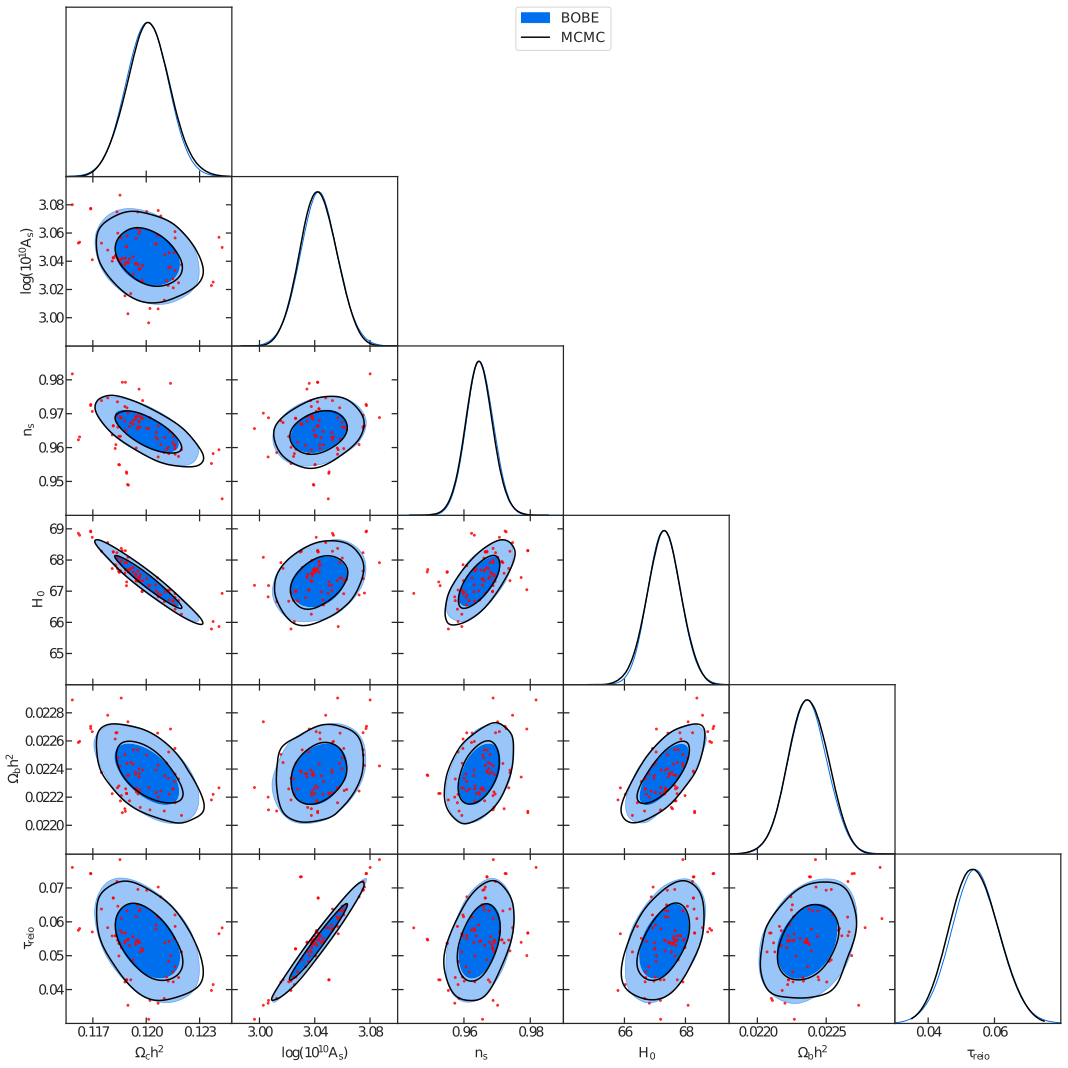
Triangle plot comparing BOBE posterior samples (blue filled contours) with MCMC reference samples (black contours). Red scatter points show the GP training data locations. The plot demonstrates excellent agreement between BOBE and the reference MCMC sampler across all six cosmological parameters.
# Print timing analysis
print("DETAILED TIMING ANALYSIS")

timing_data = results_manager.get_timing_summary()

print(f"Automatic timing: {timing_data['total_runtime']:.2f} seconds ({timing_data['total_runtime']/60:.2f} minutes)")
print("Phase Breakdown:")
print("-" * 40)
for phase, time_spent in timing_data['phase_times'].items():
    if time_spent > 0:
        percentage = timing_data['percentages'].get(phase, 0)
        print(f"{phase:25s}: {time_spent:8.2f}s ({percentage:5.1f}%)")


# Plot acquisition data
acquisition_data = results_manager.get_acquisition_data()
iterations = np.array(acquisition_data['iterations'])
values = np.array(acquisition_data['values'])
fig, ax = plt.subplots(1, 1, figsize=(8, 5))
ax.plot(iterations, values,  linestyle='-')
ax.set_yscale('log')
ax.set_xlabel(r'Iteration')
ax.set_ylabel(r'Acquisition Value')
plt.savefig(f"./results/{likelihood.name}_acquisition.pdf", bbox_inches='tight')
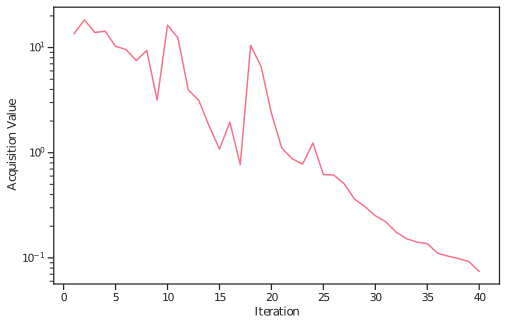
Evolution of the WIPStd acquisition function values during optimization. The acquisition value decreases as the GP surrogate becomes more confident about the posterior region, indicating successful convergence toward the high-likelihood area of parameter space.
Expected Results
For standard ΛCDM with Planck lite:
Convergence: Typically requires 100-200 evaluations with these settings. The logZ value should be approximately \(\log Z \approx -520\) (exact value may vary slightly due to nested sampler stochasticity).
Expected Runtime
For the Planck lite likelihood (each evaluation ~0.5-1 second), this run should take around 2-5 minutes. Note: total runtime may vary according to your hardware specifications.
Running with MPI
While this example does not really require MPI, for more expensive cosmological likelihoods it is recommended to use MPI parallelisation. In MPI mode, multiple processes can evaluate the true likelihood at the points proposed by the acquisition function (use as many processes as the acquisition batch size) and do GP fitting restarts in parallel, significantly speeding up the run.
# Install MPI support (from BOBE source directory)
pip install -e '.[mpi]'

# Run with 4 processes
mpirun -n 4 python examples/Planck_lite_LCDM.py
Key Configuration Parameters
The example demonstrates important settings for cosmological applications:
n_cobaya_init=4, n_sobol_init=8: Using both Cobaya reference and Sobol points to initialize the GP
min_evals=25, max_evals=250: Min and max number of likelihood evaluations to perform
fit_n_points=6: Update GP every 6 likelihood evaluations
batch_size=2: Evaluate 2 points per acquisition step
ns_n_points=6: Run nested sampling after every 6 likelihood evaluations to check for convergence once the acquisition function reaches the logz threshold
num_hmc_warmup=256, num_hmc_samples=2048: NUTS sampling for Monte Carlo acquisition function
logz_threshold=0.1: Evidence convergence threshold
For cosmological likelihoods, you should use use_clf=True.
The classifier filters out parameter regions where likelihood evaluations may return -inf or extremely low likelihoods and focuses the GP on the high-likelihood posterior region.
The SVM classifier (clf_type='svm') is used in this example and is always available without additional dependencies. The classifier threshold setting strategy is explained in our paper and follows the one used in Gpry.